Blog Description

This past summer I went on a 6 week medical observational internship in Ghana, Africa with the Abusua Foundation (an NGO run out of Ghana). I went to gain experience in a hospital and see if medicine is really what I want to do with my life. I lived in the small village of Kwaprow, in the coastal fishing town of Cape Coast. I worked in two hospitals: Cape Coast District (smaller, less modern)and Central Regional (larger, more modern). I also taught English and Science to young children of my village at the BCL after-school program.

While there, I wrote a journal about my experiences in the hospital, teaching at the after-school program, and general life in Ghana. Since being home, some people have expressed an interest in reading the journal, so I figured the easiest thing to do was to post the journal here for anyone who is interested in reading it. Any patient names mentioned have been changed to ensure confidentiality.

It should be noted that because this is a blog site, the postings are in reverse order of when they occurred (which I can't change). So, to read the entries in order you should start from the oldest posts at the bottom of this page.

About Ghana
Ghana is a coastal country in West Africa. The national language of Ghana is English. The capital of Ghana is Accra. Ghana is considered the safest country in Africa (according to global peace index; see Global Peace Index map at the bottom). In terms of development, Ghana is ranked in the middle tier of African countries and 152 out of 182 in the world by the Human Development Index.

Monetary exchange:
$1.40 CAN = 1 Cedi, 1 Cedi = 100 Pesewas


July 12, 2010


At the hospital, I started in the male ward today.  Dr. Kudoh, the doctor in charge of the male ward, came in for rounds around 10:00.  He was very nice and informative about the patients and their conditions.  As Dr. Kudoh went around the ward he probed me and the student nurses with questions about the patients. 
A patient named Thom Johnson had pitting edema (when the skin remains indented upon a firm touch due to accumulation of fluid under the skin) in both legs.  Dr. Kudoh said bilateral pitting edema indicates a systemic problem rather than an acute problem, such as varicose veins or deep vein thrombosis.  The doctor quizzed us about possible systemic causes of pitting edema, getting out of us that it may be due to renal failure (inhibited salt secretion by the kidneys leads to fluid retention), cardiac myopathy (heart is too weak to pump blood sufficiently, kidneys sense low cardiac output as decreased fluid volume, kidneys trigger salt retention, fluid levels build in blood,  blood serum leaks into and collects in interstitial cellular spaces - especially in the legs where venous return is diminished from weak cardiac pumping ), liver failure (blood protein albumin levels decrease -albumin is normally synthesized in the liver, osmotic pressure in blood decreases, fluid passes from blood into interstitial spaces) , and malnutrition (insufficient nutrient input to form blood proteins, blood serum is lost to interstitial spaces through osmosis).   I was full of questions for Dr. Kudoh, which he gladly answered.  I think I will learn a lot from Dr. Kudoh.
I also became acquainted with a second year medical student, Francis, who was shadowing doctors of CCDH during his vacation period.  Interestingly, Francis has scars on his face, which he told me were tribal scars given to him when he was a child.  He said tribal scarring is still widespread in many villages throughout Ghana.  He said they are given to ward off evil spirits.  I asked if he was angry that his face had been disfigured.  He answered that he was not because his face had been that way for as long as could remember, so he didn’t know any different. 
Francis informed me about the health insurance system in Ghana.  Citizens of Ghana pay 25 Cedi for 1 year of health coverage, which covers most hospital expenses (patients must pay for atypical tests or materials).  If parents have health coverage, their children under the age of 18 are also covered.  Without coverage, a patient would have to pay for any material or care given them.  Francis thought every citizen should take advantage of health insurance, but said some people do not due ignorance of health insurance availability, or lack of money for even the 25 Cedi payment. 
For lunch, I met some of the other volunteers for lunch at the Vegan restaurant Asassa Pa, which is popular among the volunteers.  The food was very good and cheap, and the service was good and fast (which is rare among Ghanaian restaurants).
After lunch I returned to the hospital to find that the patient with the pitting had died 15 minutes earlier.  I could not help but feel that more could have been done for Mr. Johnson with more resources.  Mr. Johnson’s body was still in the bed.  This was the first time I had seen a dead body.  It was a bit unnerving to imagine that only hours ago Mr. Johnson had been a living, conscious person, able to sense his surroundings and interact with others.  Now, however, he was a lifeless body, never to interact with anyone again.  Some thoughts of “hear one moment, gone the next” went through my head.  I reminded myself that death is an important part of life, as the prospect of death reminds us that life is finite, and so, should be lived to the fullest each day.
After the hospital I went home and relaxed, then got ready for the afterschool program. 
Today at the after-school program was more difficult than the previous day.  I continued to teach from where the kids had left off in their English books.  Some of the students did not seem to grasp the concepts, while others seemed to be bored by what I was teaching.  I have a new found appreciation for the difficulties of teaching young children.  I talked with another teacher in the program about the difficulties I had run into, asking if she had any solutions.  She teaches French and has been there for 9 months.  She said she has run into similar difficulties, and that she just tries to keep the children engaged in their studies.  She tells me that the children come from different schools and that their exposure to English will therefore greatly range.   

For homework, I instructed the students to write a 4-5 sentence paragraph about what they did today, to help me gauge the level each is at.  Hopefully once I determine the level of each child I can teach at some middle-ground.  From there I can give more challenging problems to the advanced students, while giving more help to those students who need it.

July 11, 2010


Today I got back from a wonderfully relaxing weekend with the other volunteers at the Green Turtle Lodge, a couple hours West along the coast by car.  Me and most of the volunteers went up Friday July 9 in the afternoon, and came back this afternoon.  Green Turtle is a beach lodge that caters mainly to tourists.  It is known for its beautiful beaches (Figure 16) and presence of turtles, as the name implies.  The trip was full of lounging on the beach, good food, good drink, and good people (Figure 17).
Figure 16. Green Turtle beach.
Figure 17. Abusua volunteers at Green Turtle.
After arriving back at the house, me and the other volunteers cooked some pasta and watched the world cup finals. Spain beat Netherlands 1-0.  As good of a weekend as it was, I am excited to start back at work in the hospital and with the after-school program. 

July 8, 2010


Much happened today at the hospital.  I found out the child with the severe fever I had been observing for the past couple of days had died shortly after I left the previous day.  I am sad for the child and his mother, but do not feel a strong loss, likely because I could not communicate to any significant degree with him, as we did not speak the same language.
I was able to observe my first ever surgeries, which were very interesting.  Some surgeons from other parts of Africa were here visiting as part of a program showing young med students from Florida state university around African hospitals.   I was allowed to scrub and watch from the corner of the operating room.  The surgeons were performing a partial hysterectomy (uterus, but not cervix removal) and uterine myectomy (removal of fibrous growths). 
I was very surprised how rough the surgeons were with the patients bodies. I was also surprised how large the fibrous growths were (about the size of a football!).
Additionally, I was astounded how nimble the surgeon’s fingers were and how focused the surgeon remained for the 1.5 hour surgery.  To be a successful surgeon seems to require complete immersion of oneself in the task at hand.
The surgery was a bit different then I imagine most surgeries in Canadian hospitals would be.  During the hysterectomy a persistent fly kept buzzing around the open surgical site, which the main surgeon wasn’t too impressed by.  Many of the surgical assistants also wore sandals, which I found surprising as sharp tools could be dropped on the open foot. It was also unbearably hot in the surgical room, which I imagine would make the work of the surgeon all that more difficult.    All I can say is, TIA (This Is Africa).
After the hospital, I started my first day at the BCL After-school program.  I had no lesson plan because Kojo did not drop off the kids work book, so instead I played a game to learn the kid’s names.  The game was a modified version of “duck-duck-goose”, in which we said each other’s names instead of “duck”.  As prizes I gave out pencils with Canadian flags on them, which the kids seemed really excited to receive. 
After the game, I started teaching some English from the kids work-book, which had now been found.  The work book was a 1993 English grammar from the US, which had been previously donated. We started from where the kids had left off.  As a first impression, the kids spoke English fairly well (approximately grade 4 level in Canada), but their reading and writing skills were a bit weaker (perhaps about grade 2 in Canada).  I really enjoyed the teaching experience and am looking forward to future classes.  
I learned that the kids attend day-school in the morning from about 8:30 A.M. – 3:00 P.M., then come to BCL afterwards, which just goes to show how highly motivated the kids are to learn.
Back at the house, the house cook, Fati, had prepared dinner, which was rice, vegetables, and goat meat.  Fati, is a local Ghanaian woman about 26 years old.  She has an odd sense of humour.  For example, she finds it hilarious anytime (which is often) that I almost set myself on fire while lighting the stove top. 
At the Abusua house, we are provided with breakfast and dinner.  For breakfast Fati cooks a rotation between oatmeal, French toast, crepes, and, on special occasions, omelettes.   Dinner is usually rice with some sort of sauce and, if lucky, some meat (chicken, goat or beef intestine) and vegetables.   Volunteers get their own lunch. 
Fati’s meals are tasty, but the portions are always very small.  If still hungry, peanut butter and jam is provided for sandwiches.  Luckily, I really like PB and J sandwiches.

July 7, 2010


At the hospital, the 11 year old boy with the severe fever still looked in bad condition, but was holding in. 
Me and Rob visited the hospital lab and were shown how the blood tests were done (antigens for B, A, and Rh added to identify whether the patient is A, AB, O and positive or negative for Rh factor or not).
From some of the student nurses, I learned that the nursing program is 3 years, which is undertaken after completion of senior high school.  Students in the nursing program alternate between practical (in the hospital) and theoretical (lecture) learning, followed by tests in each.  Students rotate between the district and regional hospital.  Students live in dorm-style housing near the hospitals.
After the hospital, I met with the director of the BCL after-school program, Kojo.  Kojo grew up and lives in Kwaprow, is in his final year of a BSC in math at UCC, and runs BCL in his spare time.  BCL was named after the first letters of Kojo’s last name (Bode), as well as 2 other former volunteers (Chantal and Lakai) who helped co-found the program.
The BCL after-school program started in 2006 with a mission statement to further the education of willing youths from Kwaprow village in English, math, science and international languages.  Kojo said another important goal of the program is to keep kids off the streets and out of trouble.   Classes are held Monday – Friday, from 4 - 6 P.M.  Students attend two classes which run for approximately 55 minutes each.  Class length may change however due to late arrival of students or teachers.  Students are separated into three grades based on approximate academic level: primary 5 (age 9-10), primary 6 (10-11), and junior high school 1 (11-13).
In the Ghanaian school system, kids start primary school usually at age 7 (though this may change due to the situation of the family), after 2 years of kindergarten.  Primary school goes from grades 1 – 6.   After primary school, kids attend 3 years of junior high school, followed by three years of senior high school or trade school.  After trade school, a student may enter the work force.  After senior high school, children may attend university (4 years), or a professional program, such as medicine (6 years), or nursing (3 years).
Kojo wants me to teach English to class 5 and 6, Monday, Wednseday, and Thursday from 4 – 6P.M.  He was a bit unclear about what topics exactly to cover, but said he will drop off the kids English work book, so that I can figure out what to teach from there.
On a side note, I learned that the name Kojo is a Ghanaian name for anyone born on Monday.  Ghanaian names are given depending on the day of the week one is born.  Because newborns commonly do not make it past the first week of life, a temporary name is given to a newborn, which is later changed (usually) when the newborn becomes older.   My Ghanaian name is Kwame because I was born on a Saturday.  Below is a list of Ghanaian names (Table 1):
Table 1. Ghanaian names.
Day of birth    Female                         Male
Monday           Adwoa(ajua)               Kwadwoo, Kojo
Tuesday           Abena                         Kobena, Kwabina
Wednesday     Ekua, Ekuwa               Kweku (kwayku)
Thursday         Yaa                             Yaw, Ekow
Friday             Efua, Afua                    Kofi
Saturday          Ama                            Kwame
Sunday            Esi, Akosua                 Kwesi, Akwasi          
At night, I and the other volunteers went to a local bar called The Goil to watch the semi-final World Cup game (Spain vs. Germany).  The Goil caters mostly to the local Ghanaians.  It is part of a gas station that has a bar and food area outside.  There was a large projection screen to show the game, which many locals came to watch even though they weren’t buying anything.  Beer at the Goil was the cheapest I have seen, 2 Cedi for 675 mL (the standard size beer comes in :) ).

July 6, 2010

I will take this moment to talk about the taxi system in Ghana. There are 2 types of taxis: shared or drop. Shared taxis are like a bus (they go along a fixed route and you get off and on as you please), while drop taxis are like a normal taxi (driver takes you where you want for a negotiated rate). The best bet for getting a shared or drop taxi is to go to a station (Figure 14), but you can also catch a taxi along the road (provided it is not already full). Shared taxis are much cheaper than drop taxis for one person (about a 0.3 Cedi shared = 2 Cedi drop), but a drop taxi may be worth it if you need to get somewhere fast, or you are travelling with a group. The catch with shared taxis is that because you must wait for a shared taxi to fill, the time needed to get anywhere in a shared taxi can vary, depending on your luck with other passengers.
Figure 14. Taxi-station.
Already, driving in Ghana seems as dangerous as I had been warned about.  It is very common to see a taxi and tro-tro driver pass cars using the oncoming lane, while only narrowly missing oncoming traffic.  It is also a common sight to see cars stuck on the side of the road (Figure 15), apparently after swerving to miss an oncoming car. 
Figure 15. Tro-tro ran off the road.
To get to the hospital, I have to take 3 shared taxis and it can take anywhere between 25-45 minutes to get there.
 
At the hospital today, I checked vitals of the patients in the paediatric ward.  As I was about to take the vitals of one girl suffering from malaria, the mother asked if I could wait because her child needed to vomit.  There were no available buckets nearby, so the girl puked on the floor.  All the other nurses and patients acted as if this was no uncommon thing.  I looked around for cleaning supplies, but couldn’t find any.  Finally, I asked whose responsibility it was to clean the vomit.  I was surprised to learn that it is the mother’s responsibility to clean up their child’s vomit.
 
The next child I checked was an 11 year old boy also suffering from malaria.  He was sweating profusely and somewhat delirious, his temperature was 40º C, a dangerously high temperature.  I ran and got one of the nurses.  They said the child had already been given the necessary medication an hour ago and the temperature would soon go down.
After the hospital, I went for a jog around UCC campus to blow off steam, and then relaxed with the other volunteers at the house.


July 5, 2010

Today was my first day at Cape Coast District Hospital (CCDH; Figure 12), the hospital I will be an intern at for the next 6 weeks. CCDH is located on beautiful beach-front property (Figure 13). CCDH has a male, female, paediatric, maternity, and isolated (for easily transmitted diseases, such as tuberculosis (TB)) ward. There is also an out-patient department (OPD; where patients are seen first then admitted later to a ward if it is serious), family planning center (for pre-and post-natal care), mortuary, and eye and dental clinics. There are also two operating theatres.


Figure 12. Cape Coast District Hospital (CCDH).
Figure 13. Beach-front view of CCDH.
I started in the paediatric ward, following the doctor on rounds as he examined patients.  The mothers and children spoke only Fante (the local language) for the most part, so the doctor spoke to them in their language, which made it difficult for me to understand the exchange.  In coming to Ghana, a country in which the national language is English, I hoped to avoid a language barrier.  Hopefully, future exchanges between doctors and patients will not be restricted to the local language.
On my first day, the nurses showed me how to take vitals.  Vitals that are measured are: temperature, pulse rate, respiratory rate, and blood pressure (for adults only).  Temperature is measured by a thermometer under the armpit for 3 minutes.  Pulse rate is taken by checking the pulse for 1 minute.  Respiratory rate is taken by noting the number of breathes in a minute.  Blood pressure is taken using a Sphygmomanometer (apparatus with inflatable cuff).  The nurses were extremely friendly and had a good sense of humour.   
The doctor told me the typical daily routine of the hospital.  Doctors do ward rounds (patient re-evaluation) in the morning between 8:30 and 10:00 A.M. , then go to the OPD for a couple hours.  The afternoon is reserved for any special procedures, such as surgery.  One doctor remains on call throughout the night in case of any emergencies.  Doctors may also be required to visit rural clinics a few hours each week.    
For the nurses, their jobs are to monitor patient conditions, administer medications, and ensure comfort of the patient.   Patient vitals are continually checked every 4 hours (unlike in Canada there are no machines to constantly measure vitals).  At 1 P.M., the medications are administered.  In the afternoon patients are washed by the nurses.  The rest of the day and night, nurses oversee the patients.  If unable to eat, patients are fed by the nurses.  The hospital provides three meals a day, which can be purchased by the patient.  Patients may also eat food that is brought by family members.

July 4, 2010

I left Toronto airport (Figure 1) early on July 2 and arrived in Accra, Ghana (Figure 2) on July 3 at 2:30 local time (4 hours ahead of eastern standard).
Figure 1. Leaving Toronto.

Figure 2. Arriving in Accra, Ghana.


I was greeted at the airport by Paige, a program coordinator for Abusua.  We left Accra right away on a tro-tro (cramped van that holds 14 people and is the cheapest form of public transportation; Figure 3).  From what I saw of Accra, it seemed a very hectic city.
Figure 3. Tro-tro.


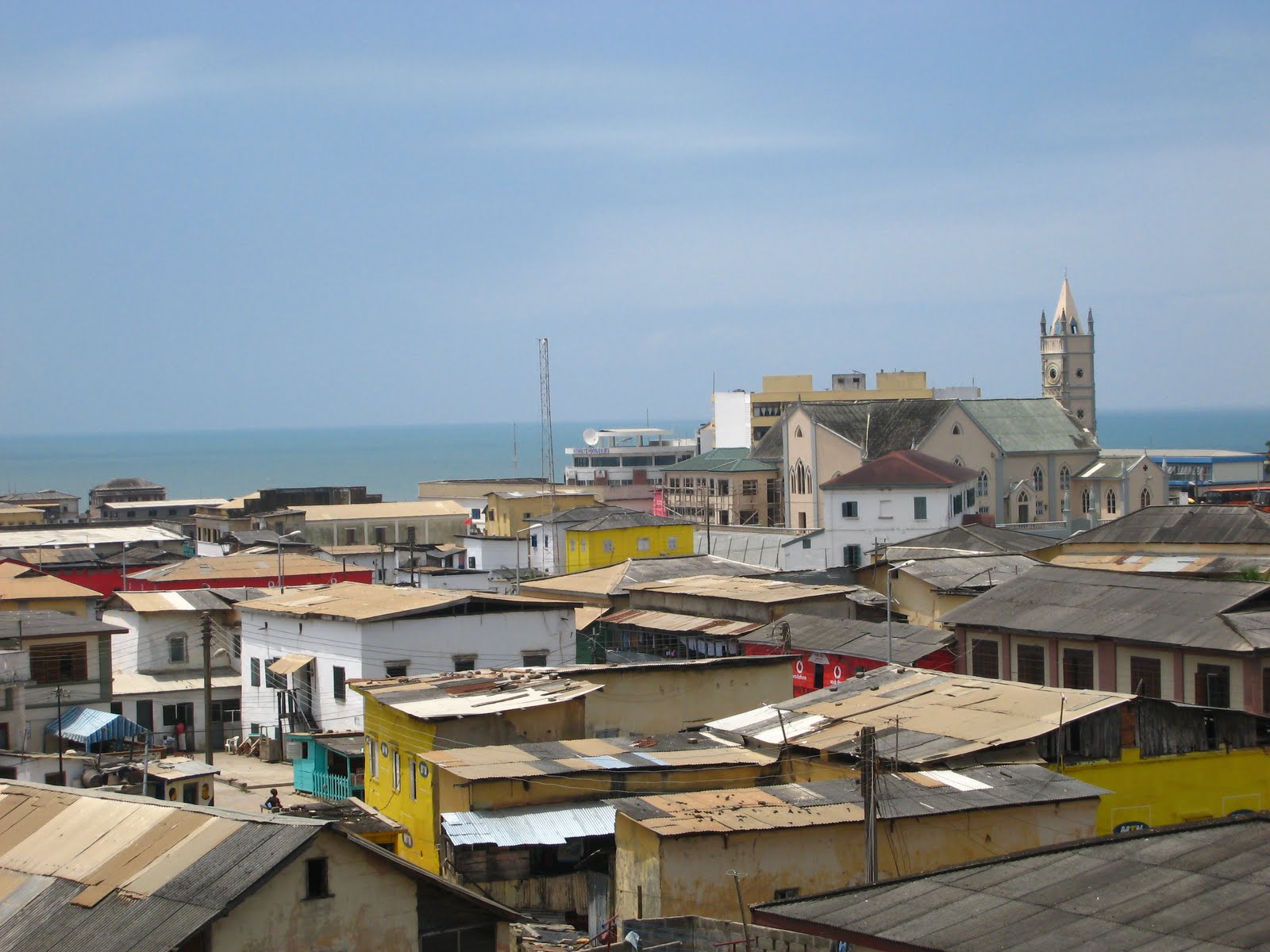
We arrived in Cape Coast, the main city I will be staying in for the next 6 weeks, at about 6:00 P.M. (Figure 4). Cape Coast is a fishing town, and is one of the larger towns in Ghana.  The streets of downtown Cape Coast were very busy (Figure 5).  
Figure 4. Cape Coast, wide-shot.
Figure 5. Busy streets of dowtown Cape Coast.
We left downtown Cape Coast soon after to go to the village I will be staying in, Kwaprow (Figure 6).   Kwaprow is on the University of Cape Coast (UCC) campus.  UCC campus is about 22 km  in size and contains many buildings (and entire villages) that are not owned by the university.

Figure 6. Kwaprow village, on Unversity of Cape Coast (UCC) campus.
In Kwaprow, the Abusua foundation rents a house, which is where I will be living (Figure 7).  The Abusua house seems very nice by Ghanaian standards, as some of the other houses in my village are mud huts (Figure 8).  
Figure 7. Abusua house, where I lived.
Figure 8. Mud hut in Kwaprow.
In the Abusua house there is a large living room with a tv (Figure 9), dining area, and kitchen. There are 10 bedrooms where the volunteers sleep typically two to a room.  

Figure 9. Abusua house living room.

I share a room (Figure 10) with Rob, my friend from STFX, who arrived a week earlier.  Our room has its own bathroom .  There is running water some of the time, but the water is not safe to drink.  There are no showers as they are usually known,  instead we use “bucket showers”, in which one fills a bucket with water and pours water over oneself  (Figure 11).  The room is not too glamous, but it works.  
Figure 10. Bedroom.  My bed on the right, Rob’s on the left.
Figure 11. Bathroom with bucket shower.
I met some of the other house-mates, and we went out for drinks at a local beach bar/restaurant, Oasis, which caters mostly to tourists.  The other house-mates seemed very nice.